fredag 25. mars 2011

The Future of The English Language


When the threat of nuclear war was imminent the BBC broadcasted "Threads". A dark prophesy of the horrors of nuclear winter. After 13 years society has eroded to the brink of being no society at all. No society, no law, no language. In "Threads" the languages of the world has retarded it's way back to simple words and moans? Is this happening already?

In non English speaking countries in Asia business men have developed their own version of English called Globish. The term was coined by Madhukar Gogate, who later published the first English-Globish dictionary. Globish is a simplification of the English language meant for those who doesn't speak English as their first language. Globish simplifies both the orthography and pronunciation of English making it easier to read for many.

For example:

dha warld waunts pis aend prausperiti... (The world wants peace and prosperity.)

hee iz faain: (He is fine)

du yu no vear dha laaybrari iz? (Do you know where the library is?)


Is this a development of the English language or a step backwards? According to Wikipedia a language is:
"Language may refer either to the specifically human capacity for acquiring and using complex systems ofcommunication, or to a specific instance of such a system of complex communication". But when a language devolves is that the direction to go? Will we all eventually speak the same language based on a simplified English? Or will everyone speak English as we now know it?

torsdag 24. mars 2011

The Swansong of Dirty Harry


Last week we saw "Gran Torino" in class. Taking double shifts as director and main character, Clint Eastwood guides us through the everyday of any average pensioner. At first the film seems like a late sequel to "Dirty Harry". With Harry Callahan as a retired industrial worker in a neighborhood ravaged by crime.

We join the action right after Walt (Eastwood) has buried his wife. The disgust on Walt's face is so apparent, when his granddaughter enters the chapel showing a piercing in her bellybutton. It doesn't take long to see that Walt is a bitter old man. He worked on a Ford plant for decades, his friends are dead or just as bitter as him. One day this changes. A Hmong family moves in next door. Their family values compared to the conservative mindset of Walt, leads to an inevitable culture clash.

The son in the Hmong family, Tao, is reluctantly recruited into a local street gang. For his initiation he is steal Walt's titular 1972 Ford Gran Torino, but the plan is foiled by Walt. As punishment the Family sends Tao over to work for Walt. Reluctant at first, Walt accepts. Their relationship evolves over a few weeks and Walt becomes attached to the Hmong family. The street gang doesn't take kindly to Tao's new way of working and making a living. After the gang tries to murder Tao, they set out for revenge.

You can compare "Gran Torino" the British film "Harry Brown". They both follow the same basic plot line; old bitter man, cleaning up the neighborhood (with guns). "Gran Torino" veers off this path and leads to Walt's redemption. "Harry Brown" on the other hand follows through leading to violence, torture and every other far-right violent fantasies.

torsdag 17. mars 2011

Atlas Shrugged


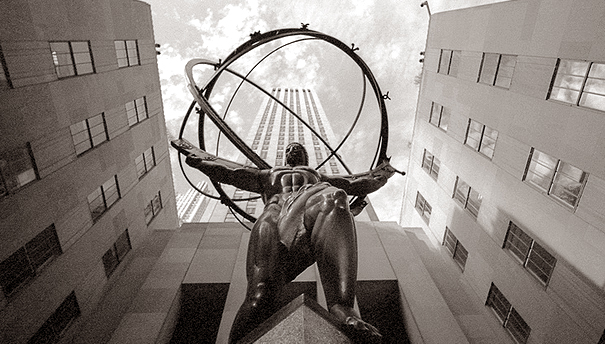
The title of Ayn Rand's famous novel is taken from the legend of Atlas, the primordial Titan of Greek mythology, who carried the weight of the world on his shoulders. In the novel Ayn Rand asks what would have happened if Atlas shrugged?

Sometime in 2008 I began reading "1984" by George Orwell. It took me about a week to finish it. Not long after I picked up "Animal Farm" and read in two days. I suddenly found myself interested in modern classical literature that have stood the test of time. These include "Fahrenheit 451" by Ray Bradbury, Slaughterhouse 5" by Kurt Vonnegut, several H.P. Lovecraft short stories and many more.

Sometime before Christmas I began reading "Atlas Shrugged". "Atlas Shrugged" is the magnum opus of famed author and philosopher Ayn Rand. The novel sparked both praise and criticism when it was released, in 1957, and continues to do so. The novel is often seen as the bible of the "hardcore-capitalist" reflecting Rand's ideals of a minimal state and a free market. Rand puts her philosophy to good use in her plot set in a pseudo-collectivist United States ca. somewhere in the future after 1957.

The plot takes place in "dystopian" version of the United States in a huge recession. The financial crisis has brought America to it's knees and the government has nationalized several of the nation's leading companies. Taggart Transcontinental is one of the few railroads still running, on fumes, and oil-prices are at an all time high. Dagny is seemingly the only on in her company who realizes that the empire is crumbling and sets out to save it. We follow Dagny in her struggles against the state, sexism, her own brother, the "looters" and everyone else, seriously EVERYONE! Her only ally is Henry "Hank" Rearden owner of Rearden Steel, who is otherwise totally unlikeable, and later a mysterious "jack-of-all-trades, master of all" John Galt, who is kind of a douche.

After a number of nationalizations and ratification of new laws making it impossible for large companies to operate in the states, their executives disappear one by one. They have basically gone on strike and it doesn't take long until the country notices how important skilled business men are to keeping the economy floating.

The plot is interesting, but it is too bad doesn't really kick off until part two of the novel, in other words the first 339 pages meanders through pointless plot-points, a train ride and numerous flashbacks. Rand's language is also polarizing. It is written in poetic way and feels very staged. There is no spontaneous conversations, but carefully rehearsed scenes. As a result the characters doesn't feel real. The reader has no emotional contact with Dagny or Hank. You will often ask yourself why they are the ones you're supposed to root for. On the other side the antagonists or "looters" are even more unlikeable so you won't sympathize with them either.

And that is a problem. Rand tries with "Atlas Shrugged" to teach her philosophy to the reader, and at the same time answering to criticism, asking herself critical questions. She does this with discussions between characters, but the characters are so far left- or right-winged that there is no room for a middle ground. In Rand's America you're either a good guy or a commie.


Being the 7th longest novel written in English with it's 565,223 words on 1170 pages the novel feels like a waist of potential. Rand has a story to tell and a philosophy to preach, but it's a shame she can't deliver.

fredag 11. februar 2011

Megacities


LA in 2019 as depicted in the movie "Blade Runner"(1982)


The cities of the world are growing. The largest are growing into "megacities" with more inhabitants of more than ten million people in the metropolitan area alone, more than a small country. In 2011 there are 21 megacities in the world.

The biggest of the all is Tokyo with more than 33 million inhabitants. The amount of people alone is a problem itself. In the megacities of India a third of the population is homeless and crime is at an all time high. There is an enormous gap between the wealthy and the poor.

This also leads to gentrification issues. The poor are being economically forced out the inner city to slums on the outskirts. Traffic congestion is a major issue, that also brings environmental challenges and smog.

There is also speculation that with so many inhabitants from diverse cultures the native language and customs will fade out creating it's own culture different from the rest of the country, like in LA in "Blade Runner" where almost every neon sign is in Chinese.

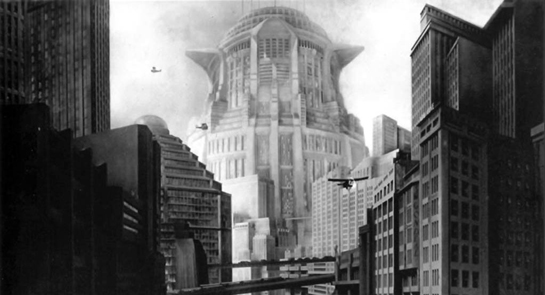
The megacities and their outskirts and suburbs will slowly merge together creating a megalopolis or mega-region. Travelling between mega-regions is informally known as "mega-loping". Some of megalopolises even cross borders like "Centrope(southern Poland, Slovakia, Austria, Hungary and the Czech Republic). The Mega-region around Istanbul reaches over two continents!


"The Tower of Babel" from "Metropolis"(1927)

fredag 28. januar 2011

End of Aparheid


In 1990 Nelson Mandela was released from prison after serving for 28 years. He was elected President of South Africa in 1994 and served for four years. When he took office South Africa was a divided nation. Divided by race and poverty. How did Mandela manage to reunite South Africa as a nation of black and white?

When Mandela took over the preparations for the rugby world cup, hosted by South Africa, already under way. Rugby was an almost unanimously white sport in South Africa, but Mandela saw an opportunity. He would unite South Africa under a team, the South Africa Springboks, a team all black South Africans hated, but Madiba was determined. After several successful PR-tours for the team, the interest for rugby increased before the world cup. It was crucial for the nation of South Africa to overcome expectation and maybe even win! And they did!

When captain of the Springboks Francois Pienaar received the trophy Mandela walked out on the field and congratulated him in a Springbok jersey and cap. For many that marked the end of apartheid and a segregated South Africa.

torsdag 27. januar 2011

Post 9/11


In 2010 Cracked.com released their tongue-in-cheek awards for the last decade. Awards went to best TV-show, best video-game and best viral video, which for some strange reason went to "2 girls 1 cup". Candidates for "New Word of the Decade" was e.g. Tweet and Green, as in eco-friendly. The word that interested me though was "Post- 9/11!".

We all remember where we were and what we did that day nearly ten years ago. When Al Qaida attacked the World Trade Center and the Pentagon. A fourth plane crashed in a field in Pennsylvania. It was the first attack on U.S. soil since Pearl Harbor in 1941.

We now live in a "post-9/11" world with invasive body-scanning in Airports to the PATRIOT Act and horrible political rhetoric. But today it is mostly used as an excuse or punch line. The most famous and prominent use of the term "post 9/11" are used in politics. The most prominent use was in the legislation process of the PATRIOT Act. The PATRIOT Act is often frowned upon as it limits some civil liberties and make wire-taps and other investigative activities. Even censorship of Radio and TV have been forced to stop airing reruns of certain "un-American" TV-episodes and a list of several hundred songs deemed inappropriate and not to be played on radio because of their lyrics. The term "post-9/11" has also in some instances been reduced to one of the worst pick-up lines ever; "hey we should totally hook, or the terrorists win".

Maybe the men and women of the future will learn about our time as "Post-9/11" next to the Cold War, industrial age and the Renaissance in history class.

fredag 17. desember 2010

Christmas movie


Today we saw Narnia in class. To me the movie isn't very "Christmassy", but an enjoyable film. Narnia: The Lion, The Witch and the wardrobe is based on the book of the same by C.S. Lewis. The book is one of many in the Narnia series which in total is seven books.

The Narnia series has many similarities with another series; Lord Of The Rings. And this isn't purely coincidental. Both Lewis and J.R.R Tolkien fought on the western front during "The Great War". Many of the epic scenes in both series draw inspiration from both writers experiences during the war.
Maybe the best example of this is seen in Tolkien's Lord Of The Rings. In the second book the protagonists cross a wasteland where there was a battle long before. In the waters and pits there are dead bodies looking up drawing people in. This is partly based on a riverbed close to the Somme where Tolkien fought. When the soldiers crossed the riverbed they could see their comrades faces staring at them with a dead gaze.

The Narnia series has a religious perspective unlike its counter part. C.S. Lewis was going through a religious phase at the time of writing and many of the characters are allusions of biblical figures, e.g Aslan having a striking resemblance to Jesus, even though he's a lion.

fredag 3. desember 2010

It's leaking!


Julian Assange, self proclaimed watchdog and future Bond villain, is again in the spotlight of the world. The liberal hacker/journalist/philanthropist is on the run from the international authorities. Accused of rape and three accounts of sexual harassment he has now gone underground.

The most recent dump of documents is mainly diplomatic gossip. It gives an honest picture of the real diplomatic relations free of any false smiles and awkward televised conversations. It shows us that official policy isn’t the same as personal opinion. American diplomats call Kim Jong Il a “flabby old chap” and Putin and Medvedev Batman and Robin. The rant goes on and on about every major world leader, but is this so terrifying?

The opinion of the diplomat isn’t the same as the country’ foreign policy, so as long as no one starts crying the world won’t end in a nuclear holocaust, yet.
When it comes to Julian Assange he is currently in an undisclosed location waiting for the diplomats to stop calling each other names, and when they do it will all go back to normal. Or at least until WikiLeaks releases a new load.

fredag 26. november 2010

Japan vs. World


In class today we read about how Japan has tackled the clash between their own and western culture.

When the Japanese surrendered after WW2 many westerners came to Japan and were shocked by what they saw. They thought of the Japanese culture as childlike and immature. But instead of folding to the western culture, the Japanese went on the offensive.

Today the phenomenon of "Manga" and "Anime" are taking over our animated culture. Disney Channel now broadcasts shows like "American Dragon" in "Anime-style". Pokemon and Digimon might not be as popular now as they were, but Japanese culture has definitely left it's mark on Western Culture.

torsdag 11. november 2010

Delivering expectations or…?


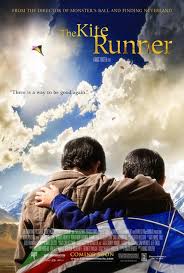
Last week we saw the adaption of the novel The Kite Runner. In the previous weeks (8 or more) we read the novel and did several tasks regarding it. The movie is a fateful adaption, and will please the ones who read it and those who's never even heard of it. on the other hand it is in a way too faithful; e.g. in a sequence where Amir returns to Afghanistan the dialogue is exactly the same. That itself is not a bad thing, but I don't think the screenplay and the novel should be the same thing.


But as always anyone who read can't help, but feel disappointed. It is an unbreakable law, we all have a different idea about how the characters look like and sound like. And when everybody's got a different idea someone is bound to disappointed. And this time it was me. It wasn't a particular person, but the feel of the movie.

Every Hollywood movie filmed that is supposed to take place in the middle east have this feel to it. They all the same music; some Lisa Gerrard or Dead Can Dance (same thing), the same visuals; a yellow filter and the same actors. I feel kind of sorry for actor Saïd Taghmaoui. I have seen him in several Hollywood-movies and he always portrays a terrorists. So it pleased me to see that he for once played a good guy.

But in the end it was an ok film. Nothing more nothing less, just bland.

torsdag 16. september 2010

Erin Brokovich


"Erin Borokovich" is a story about a single mom and uneducated legal assistant who uncovers a major cover-up of a pollution scandal in southern California. It stars Julia Roberts as the title character, Albert Finney as her boss and Aaron Eckhart as her love-interest. The movie is all about the title character and it relies on her for both plot and comical relief all the way through. If it hadn't been for Roberts performance as Erin the movie wouldn't have won the audiences hearts and minds. And that is a bad thing. There are few if any scenes without Roberts in them and those are either pointless or street shots of buildings. The other characters are one dimensional and uninteresting and only in the film to be ridiculed by Erin and to never be seen again. The film was nominated to four Academy Awards in 2001, but Roberts was the only one the film one. Steven Soderbergh lost the best director award to himself for his other film the superior movie "Traffic".

fredag 27. august 2010

The Butterfly Circus


Last Friday we watched a short movie called "The Butterfly circus" in class. The movie takes place rural part of the U.S. during the 1920s and follows Will who works in a circus. Will has no arms or legs and is just a part of an act of the circus in which he is displayed as "perversion of nature". A member of audience approaches Will, but Will just spits in the mans face. Surprisingly the man is the one who apologizes. It then revealed that the man was the director of "The Butterfly Circus".

The next day the will escaped the circus and wants to join "The Butterfly Circus" The director will let Will travel with the circus, but he won't let Will the circus as an act until he has something to show for. One day Will nearly drowns in a river, but miraculously manages to stay afloat. He eventually learns to swim and can finally join the circus.

The movie is story of hope. The hope that everyone can accomplish anything no matter what physical challenges you may have.